Pokemon Is Crushing Wall Street — But the Bigger Story Is Why
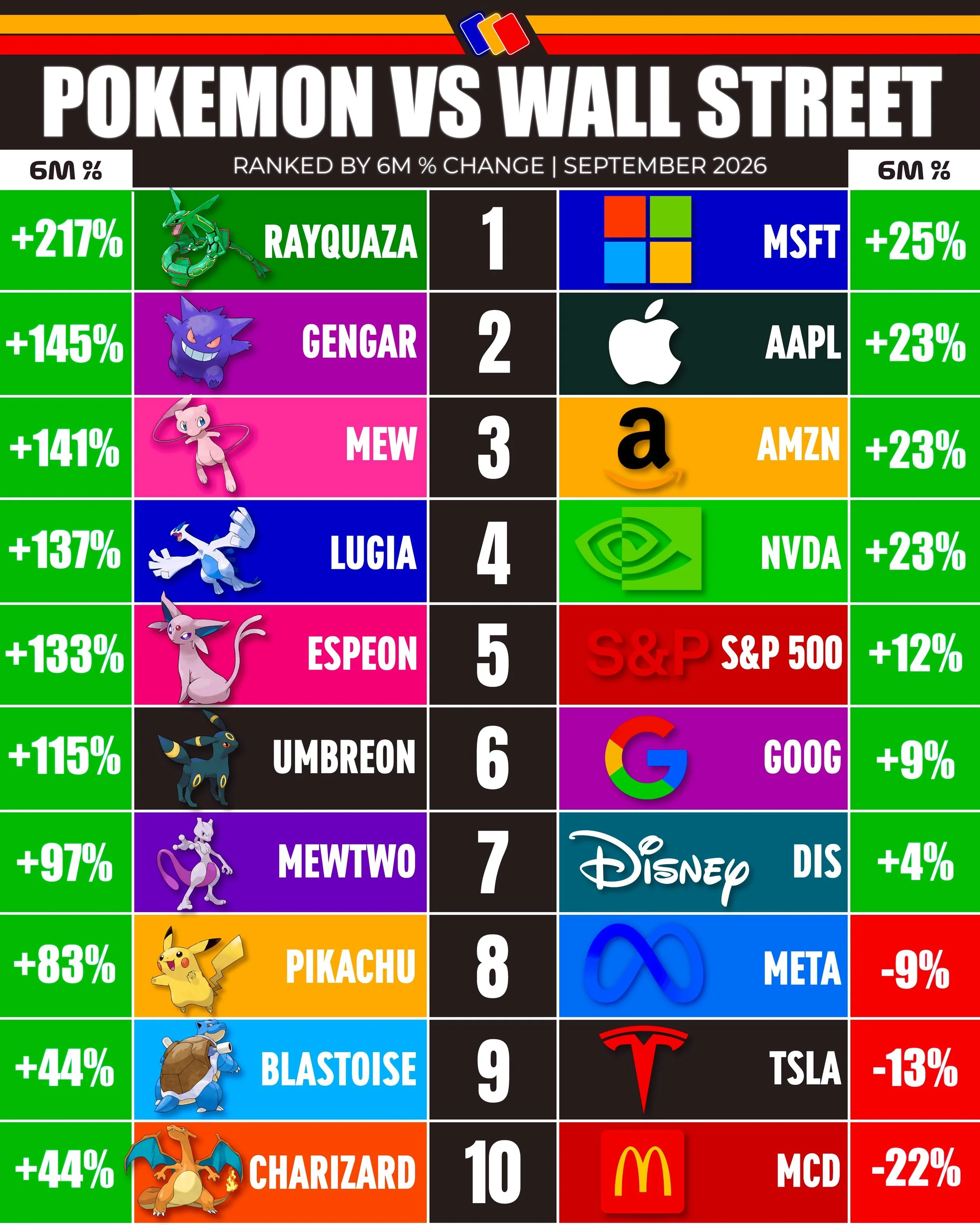
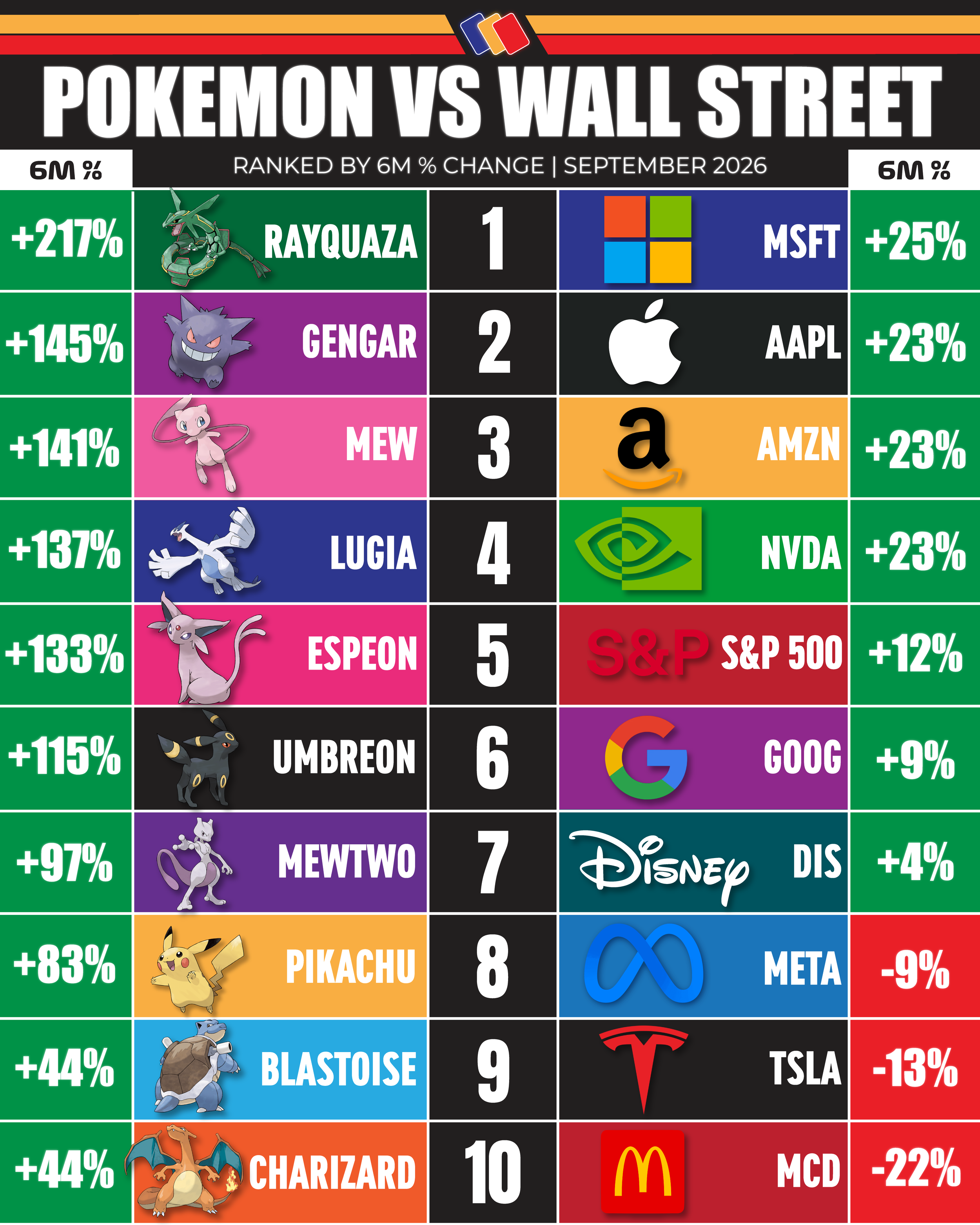
The six-month performance gap between graded Pokemon and Wall Street looks almost absurd at first glance.
Rayquaza, Gengar, Mew, Lugia, Espeon, Umbreon and other major Pokemon character indexes have all dramatically outpaced the stocks in our comparison.
But the more interesting story isn’t the leaderboard itself.
It’s why demand for graded Pokemon has been strong enough to produce returns like this in the first place.
More Supply — But Even More Demand
One of the biggest misconceptions in the hobby is that Pokemon prices are rising because there simply aren’t enough cards being made.
That’s not really what’s happening.
The Pokemon Company has been printing at enormous scale and has publicly said it is working to maximize production and reprint high-demand products as quickly as possible. Even with that, certain products continue to be difficult to buy because demand has remained extremely high.
That distinction matters.
Supply is growing aggressively, but the collector base appears to be growing even faster.
PSA says more than 9 million active card collectors have joined the community since 2023, bringing its estimate to roughly 30 million collectors in the United States alone.
That tells you something about the scale of the current hobby.
Pokemon Has Become a Global Collectible Market
The other major difference between Pokemon and a traditional stock is that Pokemon demand isn’t tied to one economy or one group of investors.
Pokemon is a global brand with collectors buying Japanese, English and other international releases across multiple markets.
That creates an unusually broad buyer base for the strongest characters and cards.
A Rayquaza Gold Star, an Umbreon grail or a major Charizard isn’t dependent on one country’s collectors deciding they want it. The buyer pool can stretch across the U.S., Japan, Europe, Asia and beyond.
That global demand becomes especially powerful when it meets fixed graded populations.
Pokemon can print billions of new cards, but it cannot print another 2004 Gold Star Rayquaza or another vintage 1st Edition Charizard.
That’s where the supply-demand dynamic becomes very different from modern sealed product.
Why Graded Cards Can Move Faster Than Stocks
Stocks are incredibly liquid.
A company like Microsoft or Apple can trade billions of dollars of shares in a single day. If demand increases, there is usually plenty of existing supply available at progressively higher prices.
High-end graded cards don't work like that.
There may only be a few examples of a particular card and grade publicly available at any given time.
If five serious collectors suddenly want the same PSA 10 and only one owner is willing to sell, the next transaction can reset the market dramatically higher.
That scarcity at the transaction level is one reason collectible markets can produce much sharper moves than mega-cap stocks.
It works in the other direction too, of course. Lower liquidity can make prices fall quickly if demand disappears.
Grading Demand Shows How Much Capital Is Entering the Hobby
Another useful signal is what’s happening at PSA.
PSA graded roughly 2 million cards in 2020. By 2025, that number had climbed above 19 million. The company says its grading capacity has increased substantially, yet collector demand has continued to outpace that expansion.
Its active backlog has remained enormous despite record grading output and new infrastructure coming online.
That doesn't automatically mean prices go higher.
But it does show just how much participation has entered the graded-card ecosystem.
More collectors means more potential buyers. More grading creates more transparent pricing. More auction activity creates more visible comps. And as the largest characters establish new highs, those prices can pull attention and capital deeper into the hobby.
So Why Is Pokemon Beating Wall Street?
The simplest explanation may be that we’re watching two very different markets at very different points in their growth cycles.
Stocks already represent one of the deepest and most mature investment markets in the world.
The graded Pokemon market is still comparatively small, illiquid and rapidly expanding.
When a relatively small collectible market experiences a major increase in global participation, prices can move much faster than they would in a trillion-dollar public company.
That doesn't make Pokemon a better investment than stocks.
It means the same amount of new demand can have a much larger impact on a smaller market.
And right now, the combination of global collector growth, constrained supply of the most desirable vintage cards, record grading activity and enormous brand momentum appears to be creating exactly that environment.
The question now is whether this is the beginning of a longer-term expansion in the graded Pokemon market — or whether prices have simply moved too far, too fast.
That’s what we’ll be watching next.
For more collectibles news, market moves, and major auction alerts, follow us on Instagram: @gempirecards.