Trading Cards Are Quietly Outperforming Wall Street — Here's the Data

July 2026 — While financial headlines obsess over tech stocks and crypto swings, a quieter story has been unfolding on the secondary market for trading card games. New market index data covering July 2026 shows that collectible card games aren't just keeping pace with traditional assets — several are lapping them.
The 6-Month Picture: TCGs Dominate the Top of the Board
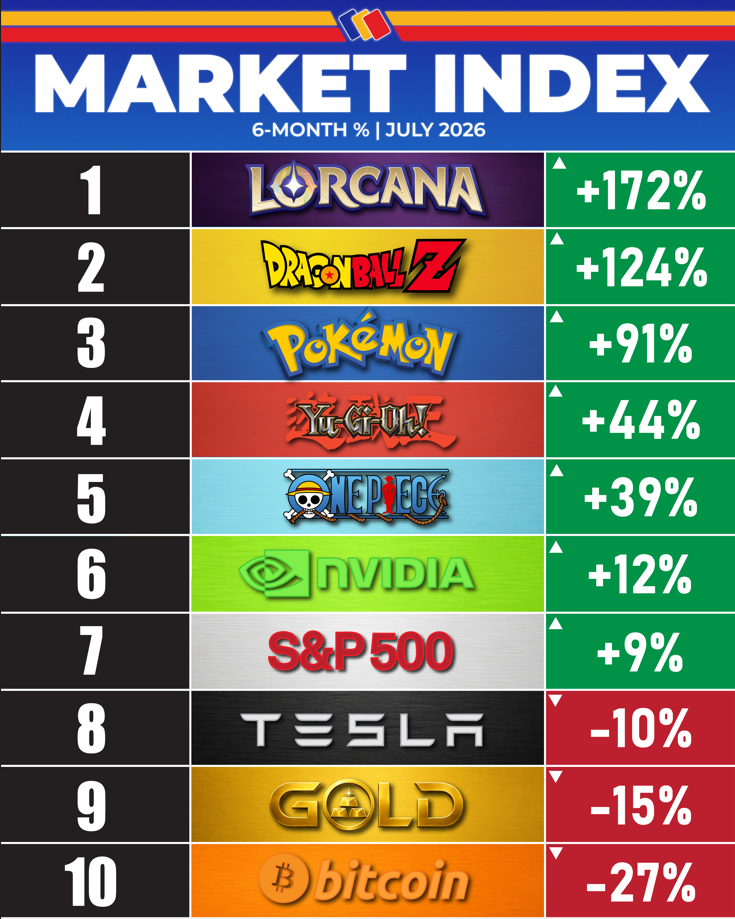
Looking at six-month performance, the top five spots on the index are all occupied by trading card and collectible brands, and none of them are close:
Lorcana leads the entire index at +172%
Dragon Ball Z follows at +124%
Pokémon sits at +91%
Yu-Gi-Oh! climbs +44%
One Piece rounds out the top five at +39%
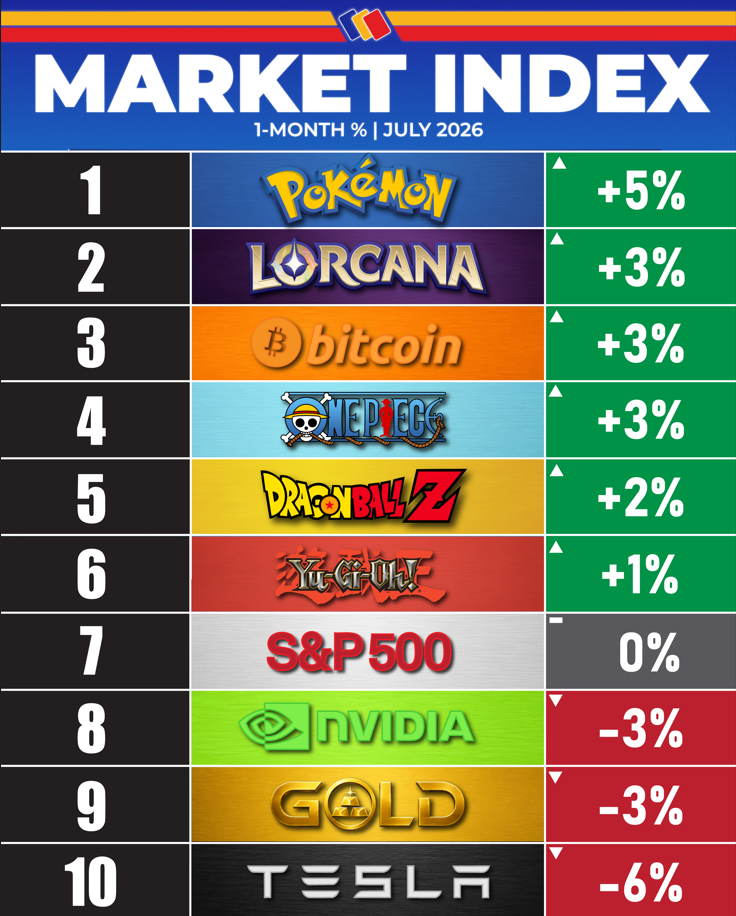
Zooming In: 1 Month Returns Tell a Similar Story
Even on the shortest timeframe tracked, the pattern holds. Every single trading card game in the index posted a gain over the trailing month, and every one of them outperformed the S&P 500, Nvidia, gold, and Tesla:
Pokémon: +5% — the best performer of any asset on the list, TCG or otherwise
Lorcana: +3%
One Piece: +3%
Dragon Ball Z: +2%
Yu-Gi-Oh!: +1%
Bitcoin also posted +3%, tying Lorcana and One Piece. But traditional benchmarks lagged behind the whole group: the S&P 500 was flat at 0%, while Nvidia (-3%), gold (-3%), and Tesla (-6%) all posted losses. In other words, this isn't just a 3- or 6-month phenomenon — card games have been outpacing stocks, gold, and Tesla on a month-to-month basis too.
Why This Matters
Three consistent patterns emerge across all three timeframes:
Lorcana is the standout performer, topping every single measurement window — 1-month, 3-month, and 6-month. Ravensburger's relatively new entry into the TCG space has clearly captured collector attention in a way few new card games manage.
Pokémon remains remarkably steady, showing up near the top of every list without the extreme volatility seen elsewhere. That consistency is notable for a franchise that's been around for decades.
Trading Card games as a category are beating traditional stores of value. Gold and Bitcoin, often pitched as inflation hedges, have lagged behind multiple TCG brands across every window measured here.
The Caveats
None of this means trading cards are a risk-free bet. Collectibles markets are notoriously illiquid, sensitive to hype cycles, and far more volatile in practice than a clean index number suggests — a chart like this reflects aggregate movement, not the performance of any single card, set, or grade. Short-term numbers (like Yu-Gi-Oh!'s dip) show that even strong long-term performers can have rough stretches. As with any collectible or alternative asset, past performance is not a guarantee of future returns, and this data shouldn't be treated as financial advice.
Still, for collectors and investors watching the space, the message from the last two quarters is hard to ignore: the card aisle has been one of the better-performing corners of the market in 2026.
For more collectibles news, market moves, and major auction alerts, follow us on Instagram: @gempirecards.